Saturday, April 9, 2011

3.4 Plant Fertilisation

Growth of the pollen tube followed by fertilization leads to seed & fruit making.


1. The pollen nucleous fertilizes the ovule, this forms the Zygote which develops into an embryo, then turns into the embryonic plant, - travels down the pollen tube.

2. Outside the ovule the seed coat forms called the Testa.

3. Cotyledons are food stores for the seedling, (it supports the plant for it's first set of leaves.)

4. Th plant put a lot of energy to thicken walls, and make fruit. (thicken walls of ovary + carpel.

5. The ovary develops into fruit & the ovule develops into seed.

Monday, April 4, 2011

3.3 - Flower structure + pollination

Observation on Lily
Pollination: arrival of pollen at stigma.
diagrams+measurements from lesson:


Measurements    - 1 petal: length              12.6cm width - 4cm
&                          -  number of sepals: 3    number of petals: 6
Appearance         -  scent: yes                    color: pink + white

Stamen (male): forms part of a circle around the carpel.
Carpel (female): is in the center of the flower
Sepal(s): looks like a petal on the lily, but is part of the outside layer
Petal: attracts insects for pollination by colour
Ovary: is where seeds are produced
Filament: supports the anther
Anther: produces pollen
Style:  connects ovary + stigma
Stamens(male): each consist of anther
                                                                                    Stigma: receives pollen

Friday, April 1, 2011

3.3b Wind Pollination

Structure of wind-pollinated flower + how each is adapted for pollination:
Transfer: pollen grain from anther -> stigma by air + wind.
 Features:
1. They travel by wind easily as pollen grains have a light weight.
    Most grains have a "wing" feature, which enables them to be transported  more efficiently.
2.  Exposed anthers help, as they hang outwards, more exposed to the wind.
3. Exposed stigmas help as well as they have a large surface area, + a "feather like" structure, having this traps more pollen better.

3.3a Insect Pollination

Structures of an insect-pollinated flower + Adaptation for pollination:
In process of pollinating flower, there is a transfer of "pollen."
Pollen: contanins the male nuclei + source of protein.
Transferred by: Insects.
Cross pollination: insects take pollen from one flower to another.

Insects: 
They get attracted by signals: brightly colored petals, petal shape, + food reward – pollen &/or nectar, fragrance


Carpel: Female organs of flower:
  • Stigma: collects the pollen from the pollinating insect , & stimulates pollen germination.
  • Style: positions the stigma for effective pollen collection.
  • Ovary: site of fertilisation, protects the developing seeds, aids in seed dispersal.
Stamen: Male organs of flower:
  • Anther: pollen formation & release.
  • Filament: positions the anther for effective pickup of pollen by the pollinating insect.

Wednesday, March 23, 2011

2.81 Phototropism

Positive phototropism of stems.
Light - growth - towards light.

Phototropism = "The way a plant grows or bends in response to light"

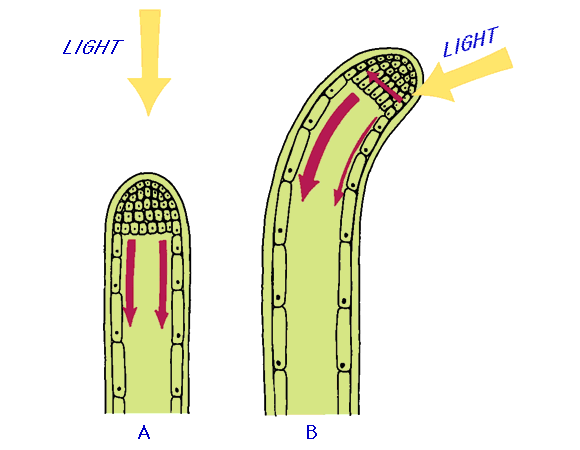
A. With light coming from all directions on the stem, it grows forwards and upwards.
B. The light is on one side of the stem, the plant bends in the growth towards the light source.

Auxin - Is a plant hormone. It is made at the top, & diffuses down the stem, & this stimulates growth. Auxin  diffuses away from the light. So in image "B", the side of the stem in more shade, is where more auxin is found, so grows faster. This causes the stem to bend towards the light.
Why do you think sunflowers were given their name?


2.80 Geotropism

Geotropic response of roots & stems.
"Geotropic" = gravity to growth response.

Sum up: Tropisms occur when plants respond to external stimuli. Tropisms are movements are movements caused by a change in a plant's growth pattern.

Negative or Positive?
Tropisms can be negative or positive. If the plant moves toward stimulus, the tropism is defined as positive. If the plant moves away from the stimulus, the tropism is considered negative. 


In this image, the trunk exhibits a positive tropism, and the roots exhibit negative tropism.

Example in a seed:

2.79 Plants & Stimuli

How plants respond to stimuli:

1. Stimuli are changes in the environment. Eg: Temp, light.
2. The plant has "Receptors" which can recognize the stimuli, & then change it into a "Response."
3. The response is often "Growth", which is called a "Tropism."

There are three types of stimuli that include tropisms that change the shape of the body.
These are:

1. Light-phototropism, = the growth of a plant shoot towards or away from the light.
2. Touch-thigmotropism, = the direction growth that is a response to touch.
3. Gravity-gravitropism, = is a response to gravity.